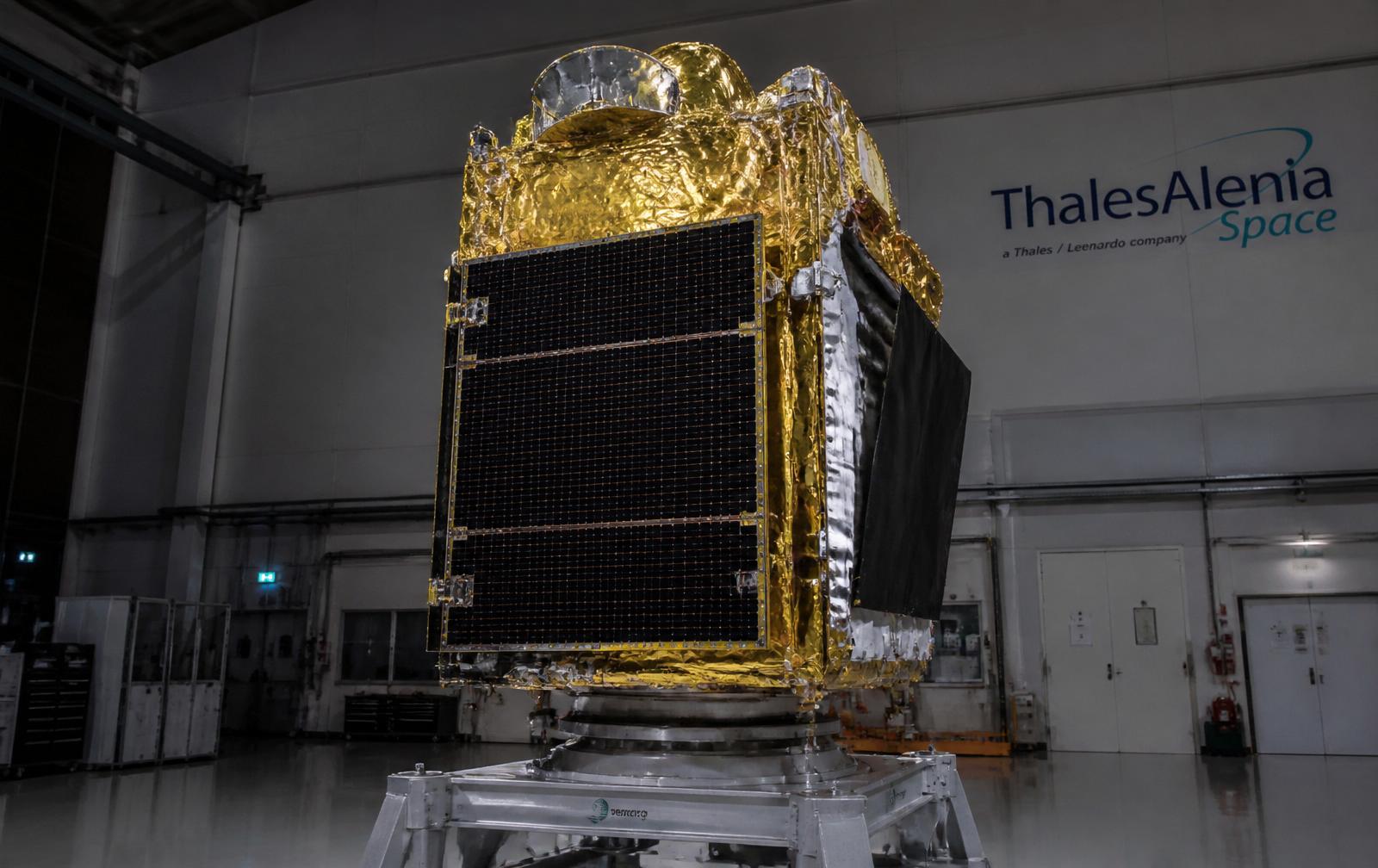
Terrestrial engineers do not think much about outgassing. On the ground, a slow release of volatile constituents from a rubber gasket is invisible: whatever leaves the compound simply diffuses into the atmosphere and is never seen again. In vacuum, that same slow release is a fault. The volatile species leave the elastomer and, in the absence of an atmosphere to disperse them, condense on the nearest cool surface - an optic, a sensor, a thermal-control coating, a solar panel. On a satellite worth several hundred million pounds, that condensate is not academic.
Low-outgassing elastomer specifications exist to prevent it. The numbers are well-defined and the qualified compound list is short. Getting it right is entirely a matter of specification and sourcing discipline.
The measurement standard
ASTM E595 is the internationally recognised test method for outgassing of materials in vacuum. A sample of the candidate material is conditioned, weighed, held at 125 °C in a vacuum chamber for 24 hours with a cooled collector plate positioned nearby, then removed and weighed again. Three numbers come out of the test:
Total Mass Loss (TML) - the percentage mass the sample loses during the test. The industry limit for space-qualified materials is TML < 1.0%.
Collected Volatile Condensable Materials (CVCM) - the percentage mass captured on the cooled collector plate. This is the number that matters most, because it represents the fraction of the outgassed material that would land on a cool surface elsewhere in the spacecraft. The industry limit is CVCM < 0.10%.
Recovered Mass Loss (RML) - the sample is subsequently held at 23 °C and 50% relative humidity for 24 hours and re-weighed. RML represents the fraction of the mass loss that was moisture, and can therefore be recovered on return to ambient. RML is reported for information and is not itself limit-bearing under the base E595 method.
A compound that meets TML < 1.0% and CVCM < 0.10% is a "low-outgassing" material. NASA's outgassing database, maintained by the Goddard Space Flight Center, is the de facto industry reference: if the compound is in the NASA database with passing numbers, it is accepted; if it is not, the burden of qualification falls on the supplier.
Which compounds pass
The short answer: specific, formulated grades of silicone, FKM and FFKM, sourced from specific compounders. Not "silicone" in general. Not "any FKM".
Elastomer compounds are not pure polymers. They contain plasticisers, process aids, cure residues, fillers, colourants and antidegradants - many of which are volatile enough to fail an E595 test. A standard commercial silicone O-ring formulated for temperature range and cost has no reason to survive E595, and it will not.
Space-grade compounds are formulated differently. Volatile plasticisers are eliminated. Cure systems are chosen for low residuals. Post-cure schedules - often 24 hours at 200 °C or higher - drive out residual volatiles before the material ever leaves the compounder. Every batch is E595-tested, and every batch ships with the test report.
The compound families most commonly specified for space work are:
Space-grade silicone (VMQ) - the workhorse for cabin seals, thermal control gaskets and low-temperature applications. Passes E595 with margin when formulated and post-cured correctly.
Space-grade FKM - used where fluid resistance is required alongside vacuum compatibility. Not every FKM formulation passes; specific grades exist and are the ones to specify.
Space-grade FFKM - used where both extreme chemistry and vacuum compatibility are required. Extremely expensive; specified only where nothing else will do.
What "space-grade" means on a purchase order
A drawing that calls for a low-outgassing compound needs to spell out three things.
The base compound. By name - silicone, fluorosilicone, FKM, FFKM - and by supplier grade where possible.
The outgassing requirement. Explicitly, in the form "shall meet ASTM E595 with TML < 1.0% and CVCM < 0.10%", or by reference to a governing spec (NASA SP-R-0022A, ESA ECSS-Q-ST-70-02C, or an equivalent).
The documentation requirement. The E595 test report shall accompany the material and be filed against the batch traceable to the delivered components.
We source qualified low-outgassing compound from suppliers with an established track record in space applications, and we supply the material data pack - E595 report, compound datasheet, batch number, certificate of conformance - with every delivery. Where a customer specifies a particular compounder or a particular NASA-listed formulation, we source to that specification without substitution.
Radiation, ultra-high vacuum and other complications
E595 is the baseline. Beyond it, the specification landscape narrows further.
Radiation-resistant compounds are required for components inside the spacecraft's radiation-exposed volumes. Silicone tolerates radiation well; FKM tolerates it moderately; FFKM tolerates it exceptionally. Elastomers with additives sensitive to gamma or high-energy proton flux need specific selection.
Ultra-high vacuum (UHV) applications - spacecraft with sensitive optical payloads, particle physics experiments - often go beyond E595 into more stringent methods with lower limits and more punishing conditioning schedules. If your programme has a UHV requirement, the compound list narrows again.
Atomic oxygen (AO) exposure on low-Earth orbit satellites attacks certain polymers. Silicone forms a self-passivating silica layer under AO exposure and is often preferred for external-facing seals; hydrocarbon-based compounds erode.
What a good specification conversation looks like
For most space enquiries, the useful up-front information is: the mission (LEO, GEO, deep space, interplanetary), the location (internal, external, cryogenic), the media exposure (fuel, propellant, thermal transfer fluid, vacuum only), the temperature envelope, and the traceability level required (commercial-grade, ESA/ECSS, NASA). From those, the compound family and the specific grade follow.
We would rather have that ten-minute conversation before quotation than discover after moulding that the specified compound doesn't meet the mission's real requirements. Space work is unforgiving of the wrong compound; it is straightforward with the right one, provided the paperwork is in place from the first delivery.