A rubber component's cost, quality and lead time are decided long before the first shot of material goes into a tool. The choice of moulding process - compression, transfer or injection - sets the tooling investment, the achievable tolerances, the achievable geometries, the material families available and the per-part cost curve. Get it right and every subsequent decision is easier. Get it wrong and you spend years compensating.
Here is how we think about the three processes when a new drawing crosses the desk.
Compression moulding: the workhorse
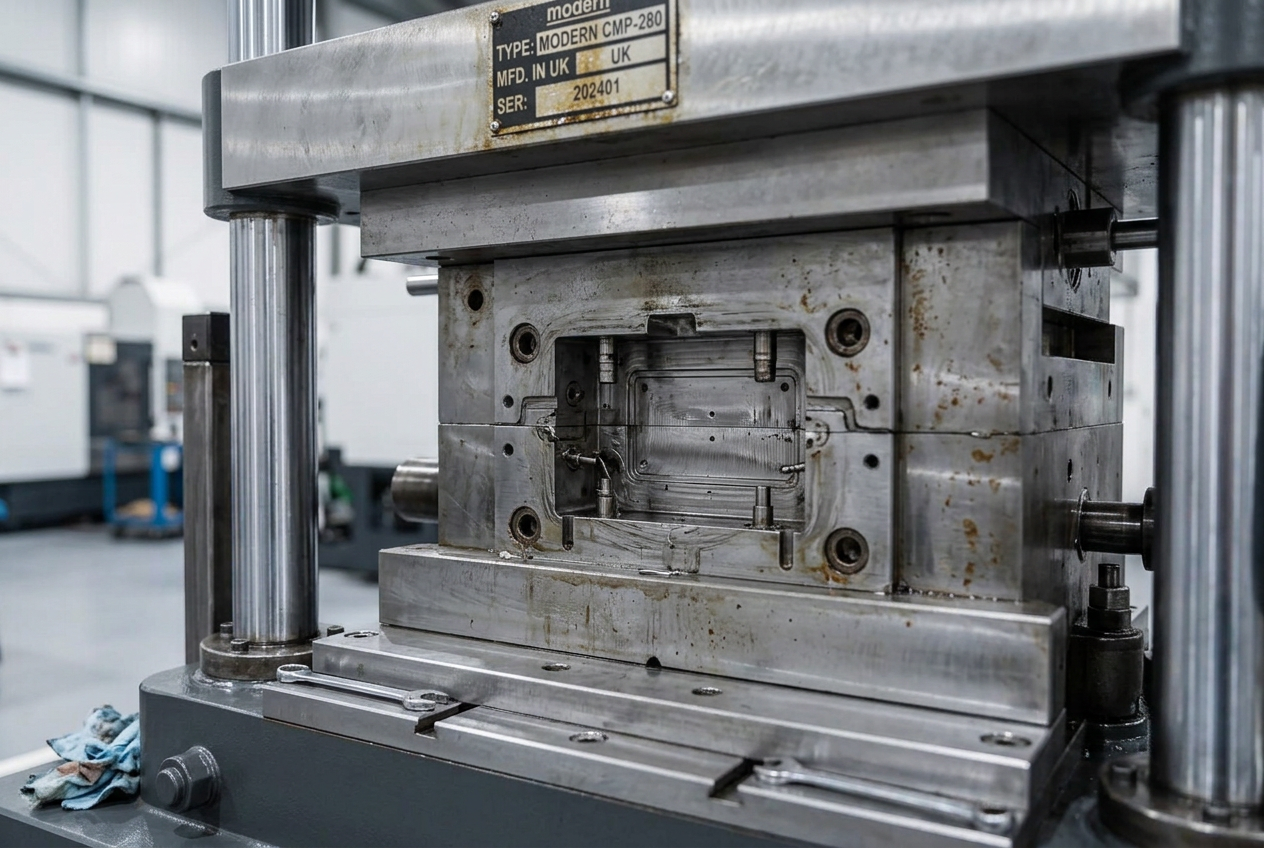
The material starts as a preform - a slug or a strip of uncured compound, weighed to a target mass. The operator opens the press, drops the preform into the cavity, closes the press, and pressure and heat cure the compound to shape. When the press opens, the part is lifted out with a hook or with tongs, still hot.
Compression is the oldest of the three processes and still the most flexible. It suits large parts (up to several kilograms per shot), thick cross-sections (where injection would struggle with cure gradients), and low-to-medium volumes where the tooling investment for a fully-automated injection tool cannot be justified.
The advantages are real: cheapest tooling of the three processes, easy to run in small batches, tolerant of many compound types and hardnesses, and - because the material starts in the cavity - no runners and minimal material waste.
The trade-offs are equally real. Cycle times are longer than injection. Flash management (the thin excess material that squeezes out at the parting line) needs a post-mould trimming operation. Dimensional tolerances are looser than transfer or injection because the closing action of the press does not meter the material as precisely.
For prototypes, short runs and thick-section parts, compression is almost always the correct answer.
Transfer moulding: the middle ground
Transfer moulding sits between compression and injection. The material is placed into a pot above the cavity - a chamber cut into the top plate of the tool. When the press closes, a plunger pushes the compound out of the pot, through a series of runners and gates, into the closed cavity below.
That single change - closed cavity, material forced in through gates - brings two significant advantages. First, tolerances improve substantially because the cavity is fully defined before material enters it, and flash is reduced to minor traces at the gates. Second, transfer handles bonded metal inserts far better than compression, because the inserts can be located in the closed tool before the material arrives, without being displaced by the closing action.
Transfer is where most rubber-to-metal bonded assemblies are produced. It is also where multi-cavity layouts - one pot feeding six or eight cavities in a single shot - become efficient enough to compete with injection at moderate volumes.
The costs: tools are more expensive than compression (the pot, the plunger, the runner system add complexity), and there is a runner-and-cull of material discarded at each shot. For most bonded and multi-cavity work, both are easily worth it.
Injection moulding: high volume, thin wall, LSR
In injection moulding, uncured compound is fed continuously through a heated screw and injected under high pressure directly into a closed, temperature-controlled tool. The tool is opened, the part ejected, and the next shot begins - often on a fully automated cycle with no operator between shots.
The strengths are what you would expect from any injection process: exceptional dimensional repeatability, short cycle times, ability to run overnight without an operator, and low per-part cost at volume. Thin-walled parts and complex geometries that would be impossible in compression become routine in injection.
Injection is also the process behind almost all medical-grade liquid silicone rubber (LSR) production. LSR is a two-component silicone that mixes at the injection barrel and cures rapidly in a hot tool. It produces components clean enough for implantable-medical applications with no post-cure required.
The barrier is tooling cost. An injection tool is easily three-to-five times the price of a compression tool of the same cavity count. Below roughly 5,000 pieces per year, the amortised tool cost per part is prohibitive. Above that number, injection wins on price rapidly and never looks back.
How the decision actually gets made
When we look at a new drawing, three questions decide the process before anything else.
Volume. Under 500 pieces per year, compression is almost always correct. 500–5,000 pieces per year, transfer is usually the sweet spot. Above 5,000, injection amortises its tool cost quickly enough to win, and above 25,000 it is not even a contest.
Inserts. Any bonded metal insert steers the choice toward transfer or injection. Compression can bond simple inserts, but complex or delicate inserts almost always want the controlled fill of a closed tool.
Material family. LSR silicone essentially requires injection. High-consistency silicones (HCR) can be moulded by any of the three. FVMQ, FKM and FFKM are typically compression or transfer for aerospace batch sizes, injection for automotive volumes.
Geometry, cross-section thickness, tolerance stack and surface finish requirements all influence the final decision, but volume, inserts and material do most of the work.
What we typically recommend
For a first article or a prototype, we push toward compression: the tooling cost is a fraction, the lead time is shorter, and if the design is going to change after the first article (which it usually does), the sunk tool cost is small.
For a bonded assembly, we default to transfer.
For a mature design entering series production above a few thousand pieces a year, we invest in an injection tool. The per-part cost saving pays back the tooling investment inside the first production year in almost every case.
The one rule
The correct process is the one that produces the required part at the required cost, on the required timescale, with the required repeatability. Everything else is opinion. If your drawing is currently being quoted by a supplier using a process that doesn't fit those requirements, the quote will tell you - usually in the price or the lead time. If either looks wrong for the part you have designed, the process is probably wrong for the part you have designed. Send us the drawing and we will tell you what we would do.