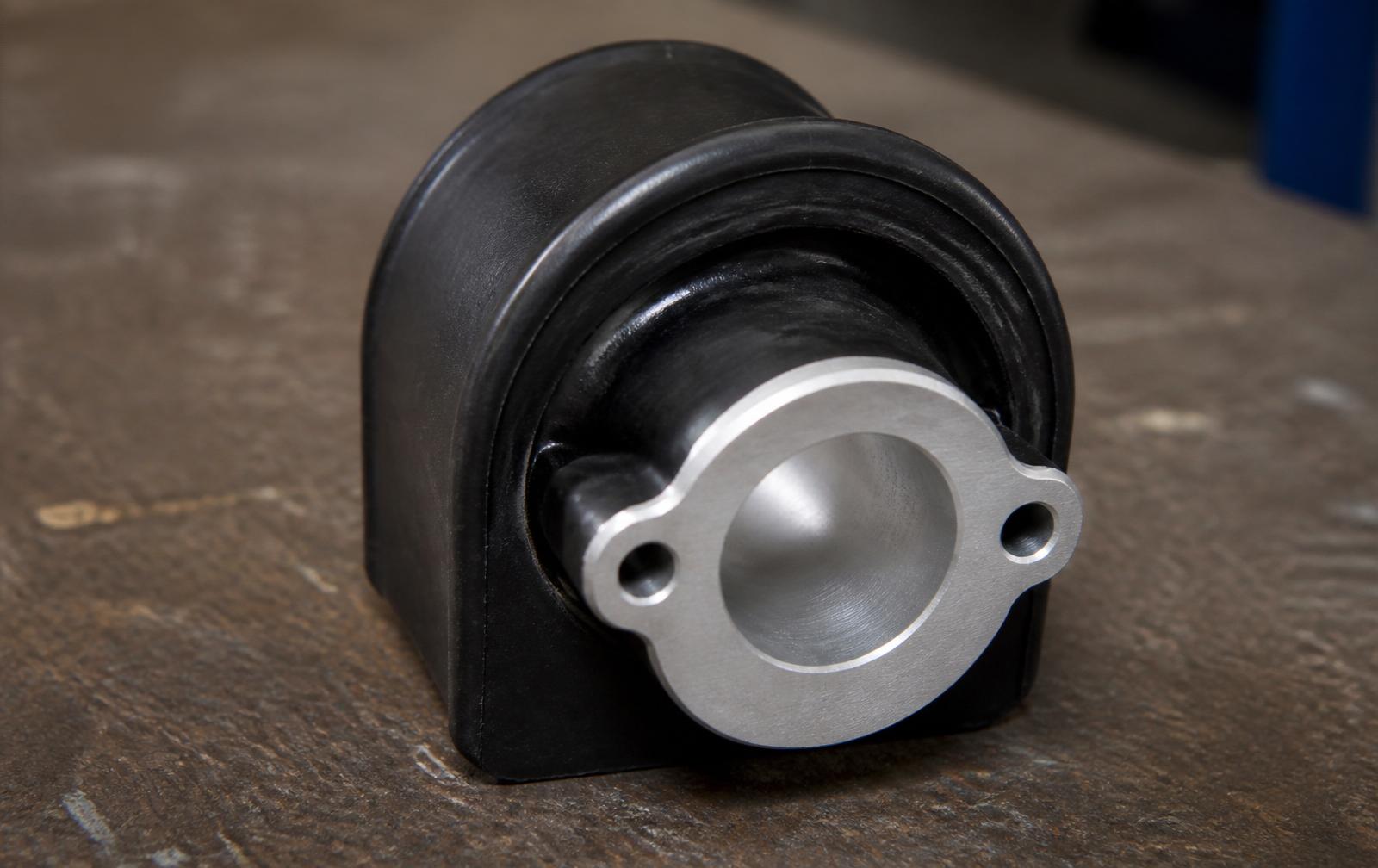
A rubber-to-metal bonded assembly is a single component made from two materials that would rather not be joined. Elastomers do not naturally adhere to steel or aluminium. Everything about the bond is deliberately engineered - surface, chemistry, geometry, cure profile - and if any part of that chain is wrong, the bond fails, usually in service, usually at the worst moment.
Here is what a good bond actually depends on, and why "the rubber came off" almost never means the rubber came off.
The three-legged stool
Every successful bond rests on three legs.
Surface preparation. The metal surface must be clean, roughened to a controlled profile, and chemically ready to accept a primer. Skip this step and the bond starts on borrowed time.
Chemistry. The right primer, applied at the right thickness, and the right top-coat adhesive, matched to both the elastomer family and the service environment. Wrong chemistry and no amount of surface preparation will save the assembly.
Process. The right cure temperature, the right cure time, the right pressure, and the right mould geometry. A perfect surface and a perfect chemistry will still fail if the cure profile is off.
Every failure investigation we have run traces back to at least one of these three. Usually two.
Surface preparation, step by step
The starting condition of the metal insert matters. A part arriving at the moulding shop with an oxide layer from atmospheric storage, a light film of drawing lubricant from machining, or fingerprints from a bare hand needs to be worked back to a chemically active state before anything else happens.
The industry-standard sequence is grit-blast, then degrease. The grit-blast media, pressure and dwell time are chosen to produce a defined surface profile - typically measured in Ra or Rz - that gives the primer somewhere to key into. Common media are aluminium oxide (angular, aggressive) or steel shot (rounder, gentler). Both are specified; both are recorded on the process card for the assembly.
The degrease that follows the blast is not optional. Even a clean blast media leaves particulate on the surface. A solvent wipe or ultrasonic clean, followed by a controlled dry, delivers the surface the primer expects.
Skip either step - or worse, do them in the wrong order - and the bond becomes a lottery. The moulded assembly will look identical. It will not perform identically.
Primer and adhesive: the chemistry choice
A modern rubber-to-metal bond uses a two-layer system. The primer bonds to the metal on one side and presents an active chemistry on the other. The top-coat adhesive bonds to the primer on one side and to the elastomer on the other. Together, they bridge two materials that will not directly adhere.
The market is dominated by a small number of well-known systems: Chemlok from LORD (now Parker), Cilbond from CIL, Megum from LANXESS. Each family covers a range of chemistries matched to specific elastomer types - nitriles, silicones, FKMs, FFKMs, natural rubber. Choosing the correct combination is a specification exercise, not a preference. A Chemlok system rated for FKM will not bond a silicone. A silicone system will not bond a fluorosilicone.
Where the service environment is aggressive - heat, chemistry, immersion - the adhesive system must be rated for that environment as well as the elastomer. A bond that survives room-temperature testing can fail in a hot oil bath if the adhesive system is not fluid-resistant.
Cure: the least visible variable
The cure step is where a lot of quiet failures originate. The elastomer's cure profile is a fixed function of its chemistry; the adhesive's cure profile is often similar but not identical. Running the tool cool to shorten cycle time will undercure the adhesive before it undercures the rubber, and the resulting bond will look perfect on inspection and fail three months into service.
Bonded assemblies are one of the applications where a well-run process record - dated, initialled, with measured tool temperature and dwell time - is not an audit inconvenience. It is a genuine quality control.
The failure modes worth knowing
When a bonded assembly fails, there are typically five diagnosable causes.
Contaminated substrate. The metal was not clean when the primer went on. The failure surface, on inspection, shows the primer separating from the metal cleanly, often with a residue of oil or drawing lubricant visible at the interface.
Wrong adhesive for the compound. The primer bonded to the metal fine, and the adhesive bonded to the primer fine, but the adhesive-to-elastomer interface failed. The failure surface shows the adhesive still attached to the primer, with clean elastomer separated from it.
Insufficient cure. The bond looks whole on inspection but peels at low stress. Cure records typically show a short cycle or a cool tool.
Thermal cycling beyond the bond's rated range. The bond survived initial commissioning fine, then failed months later after repeated warm-to-cold excursions. The bond system was not rated for the actual service envelope.
Chemical attack on the adhesive. The elastomer resists the media fine, but the adhesive underneath does not, and the media has found a path around the seal into the bond line. Common in fuel and solvent applications where the adhesive selection was made for the elastomer's chemistry rather than the surrounding fluid.
The tell-tale sign of a well-executed bond
A properly bonded assembly, tested to destruction, will not separate at the interface. The elastomer itself will tear. That failure mode - cohesive failure in the rubber, not adhesive failure at the bond - is what an inspection report should show.
If a peel test separates the parts cleanly at the metal, or leaves the adhesive on one side and clean elastomer on the other, the bond is not right. It may or may not survive in service. It will not survive an audit.
What we ask for on incoming bonded jobs
Three things, up front. First, the elastomer family and grade. Second, the metal substrate and any protective coating already on it (a zinc-plated part needs different preparation from a bare steel part). Third, the service environment - temperature, fluid, cycling. From those three, the primer-and-adhesive combination follows almost mechanically.
Sending us the drawing without the service environment is the single most common cause of a follow-up email asking the same question. Front-loading that information keeps quotes accurate and lead times honest.