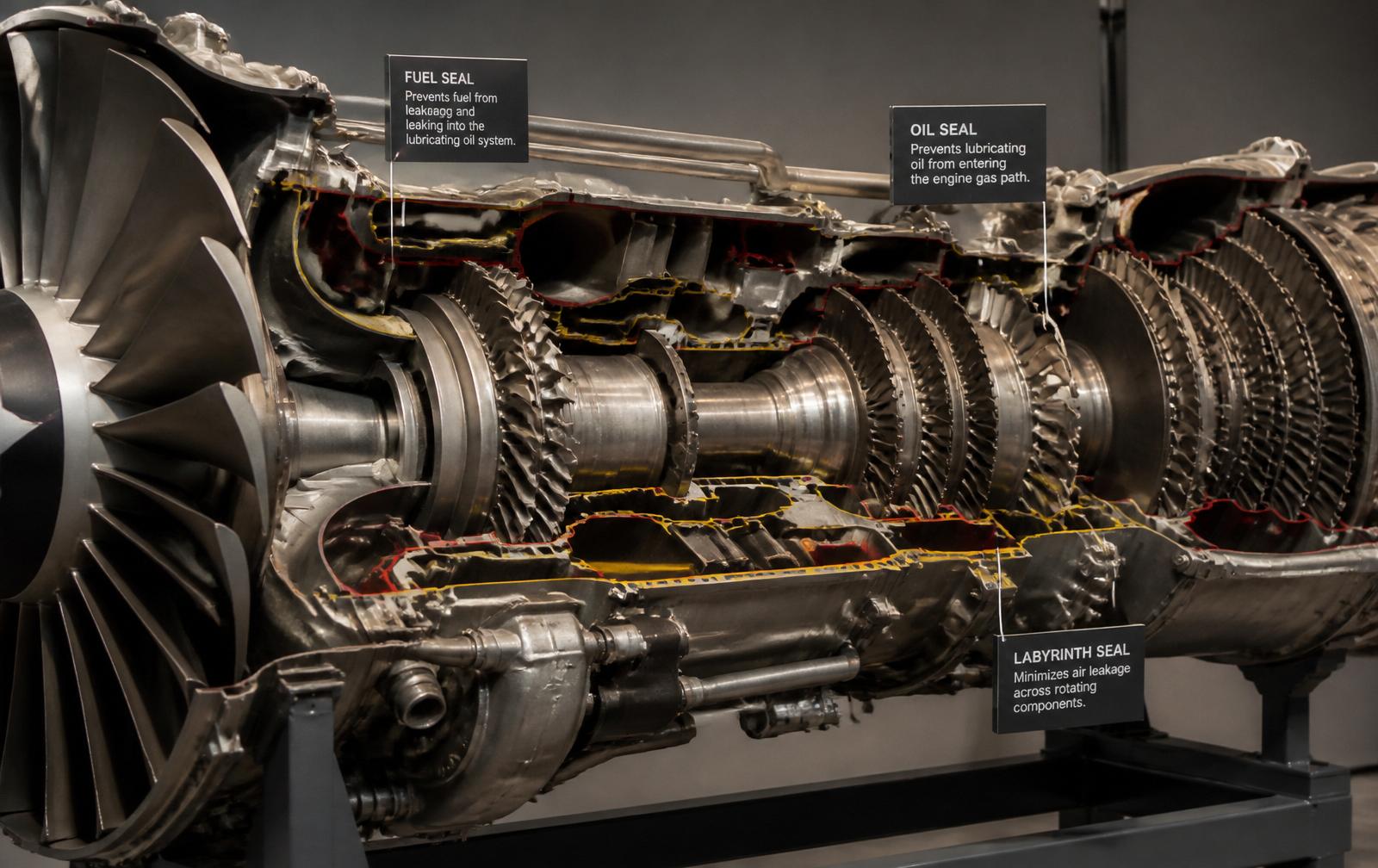
On aerospace drawings, one specification appears again and again in the material block for fuel-system and engine seals: AMS-R-25988, or its equivalent MIL-DTL-25988. Both call for a fluorosilicone rubber (FVMQ) qualified against a defined battery of tests. Both are strict. Both are routinely misunderstood by supply chains outside the direct military aerospace sector.
This post is what a purchasing engineer or a design engineer new to aerospace typically needs to know before either specifying or sourcing to 25988.
The lineage
The original specification was MIL-R-25988, a US military specification for heat-and-fuel-resistant fluorosilicone rubber intended for aircraft engine, fuel system and airframe applications. When the US Department of Defense shifted much of its materials specification portfolio to industry-issued standards, the specification was reissued in two forms:
- MIL-DTL-25988 - the current military detail specification, functionally continuous with MIL-R-25988.
- AMS-R-25988 - the SAE-issued Aerospace Material Specification, dimensionally identical for most practical purposes, and now the standard supply chains outside the direct military route use.
For a supplier, they are the same conversation. For a purchasing organisation, they are the same conversation with different administrative paperwork.
Why fluorosilicone
Fluorosilicone (FVMQ) is silicone rubber with a fluorinated side-group that gives it resistance to hydrocarbon fuels and lubricants that ordinary silicone (VMQ) cannot cope with. It keeps most of silicone's exceptional temperature range - service from around −60 °C to +175 °C is typical - while adding the fuel resistance an aircraft fuel-system seal absolutely needs.
The trade-off is that FVMQ is mechanically weaker than either an FKM or a nitrile, and it is expensive. The specification exists because there was no other elastomer family that met the temperature-plus-fuel-resistance envelope the airframe designers needed.
What the specification calls for
25988 defines the compound in three axes.
Type distinguishes the fluorosilicone chemistry family. Type 1 is the general-purpose fluorosilicone. Type 2 is a higher-strength, higher-tear-resistance variant intended for the more demanding sealing environments.
Class defines the fluid-resistance level, based on defined immersion tests in jet fuel, hydraulic fluid and lubricant. A Class 1 compound must retain its properties within specified limits after those immersions. Higher classes accept a wider deviation in exchange for other performance attributes.
Grade defines hardness in Shore A, typically supplied at 40, 50, 60, 70, 80 and 90.
A typical drawing callout looks like: AMS-R-25988 Type 2 Class 1 Grade 70. That is a specific compound family, meeting a specific fluid resistance level, at a specific hardness - not a general permission to supply "any FVMQ".
What the test regime looks like
The specification does not just list the target values - it defines the test methods, sample geometries and conditioning schedules. Tensile, elongation at break, tear strength, compression set, low-temperature retraction (TR-10), heat ageing and fluid immersion each have prescribed methods. The compound must pass all of them to be qualified. Qualification is not something a mould shop does; it is done by the compound manufacturer, with a certified test report.
Sourcing to it, in practice
Three requirements typically travel with the specification into the purchase order.
Certified compound. The FVMQ must come from a supplier whose specific batch of compound has been tested and qualified. In practice, that is a small list of compounders worldwide.
Full traceability. The batch number of the compound goes onto the certificate of conformance, and on request onto the individual component. That batch number ties back to the compounder's test report.
Certificate of conformance. Every shipment carries a certificate stating that the components were moulded from a named batch of qualified compound to a named drawing. For flight-critical applications, that certificate is the audit trail.
We source our 25988 compounds from established European FVMQ producers with the qualification paperwork and the batch history that aerospace quality demands.
Where it goes wrong
The single most common substitution error we see on incoming enquiries: a customer with a 25988-called drawing has previously bought "generic FVMQ" from a general-industry supplier. It sealed. It looked identical. It cost half as much. The certificate simply said "FVMQ 70 Shore". That is not the same product, and in an audit it would not be accepted as such. In service, it may perform indistinguishably; it may not. Either way, the paperwork trail does not exist.
For a component that will ever be certified onto an airframe, the compound must be qualified, the batch must be documented, and the paperwork must be there from day one. Retrofitting a paper trail onto an already-delivered batch of parts is, in practice, not possible.
When to specify it
25988 is written for engine and fuel system applications. If you are designing a fuel-adjacent seal, an engine-bay component or an airframe seal that will see hydrocarbon exposure and temperature, it is likely the correct family. If you are designing a cabin seal, an airframe door seal or a component that will only see air, an ordinary silicone or an EPDM is usually appropriate and much cheaper. The right specification is the one your application needs - not the strictest one on the shelf.
If in doubt, send the drawing and the environment. We would rather help you specify correctly than watch the wrong compound get quoted through habit.