An O-ring is the cheapest component in an aircraft subsystem and one of the most common causes of its unscheduled removal. That asymmetry is why aerospace O-ring selection is governed by material specifications rather than left to a designer's preference - and why the specification alone is not enough to guarantee a seal that lasts.
This guide covers the three specification families we are asked about most, how they behave in service rather than on a datasheet, and the sizing and groove decisions that determine whether the right material actually seals.
Why aerospace uses specifications rather than trade names
In industrial sealing you can quote "Viton, 75 Shore A" and get something workable. In aerospace that is not sufficient, because the trade name describes a polymer family, not a compound. Two FKM compounds at the same hardness can differ substantially in compression set, low-temperature flexibility and fluid resistance depending on cure system, filler loading and polymer grade.
Aerospace material specifications close that gap. They define a polymer type, a hardness band, and a battery of qualification tests the compound must pass - tensile strength, elongation, compression set after a defined soak, volume swell in named fluids, and low-temperature retraction. A compound that is qualified to the specification has demonstrated that behaviour; one that merely resembles it has not.
The practical consequence: on aerospace work we quote against the specification and the qualification evidence behind the compound, not against a polymer name.
AMS-R-25988: fluorosilicone, and why fuel systems need it
AMS-R-25988 (the SAE specification that succeeded MIL-R-25988; MIL-DTL-25988 remains in circulation for the same material) covers fluorosilicone rubber - FVMQ - in the 70 and 75 Shore A hardness bands.
Fluorosilicone exists to solve a specific conflict. Ordinary silicone has the widest usable temperature range of any common elastomer, comfortably down to −60 °C and beyond, which matters enormously at altitude. But silicone swells badly in hydrocarbon fuel. Nitrile resists the fuel but stiffens and eventually loses its seal in the cold. Fluorosilicone grafts fluorinated side groups onto the silicone backbone: it keeps most of silicone's low-temperature flexibility while resisting jet fuel, hydraulic fluids and lubricating oils.
Where it earns its place:
Fuel system seals exposed to both cold soak at altitude and hydrocarbon fuel. This is the classic AMS-R-25988 application and the reason the specification exists.
Static seals in engine accessory and fuel control units where the temperature swing across a mission is wider than an FKM can absorb at the cold end.
Where it is the wrong choice: dynamic sealing. Fluorosilicone shares silicone's mechanical weakness - comparatively low tear strength and poor abrasion resistance. Specify it for a reciprocating rod seal and it will abrade. For dynamic duty in the same fluids, FKM is normally the better answer despite the low-temperature penalty.
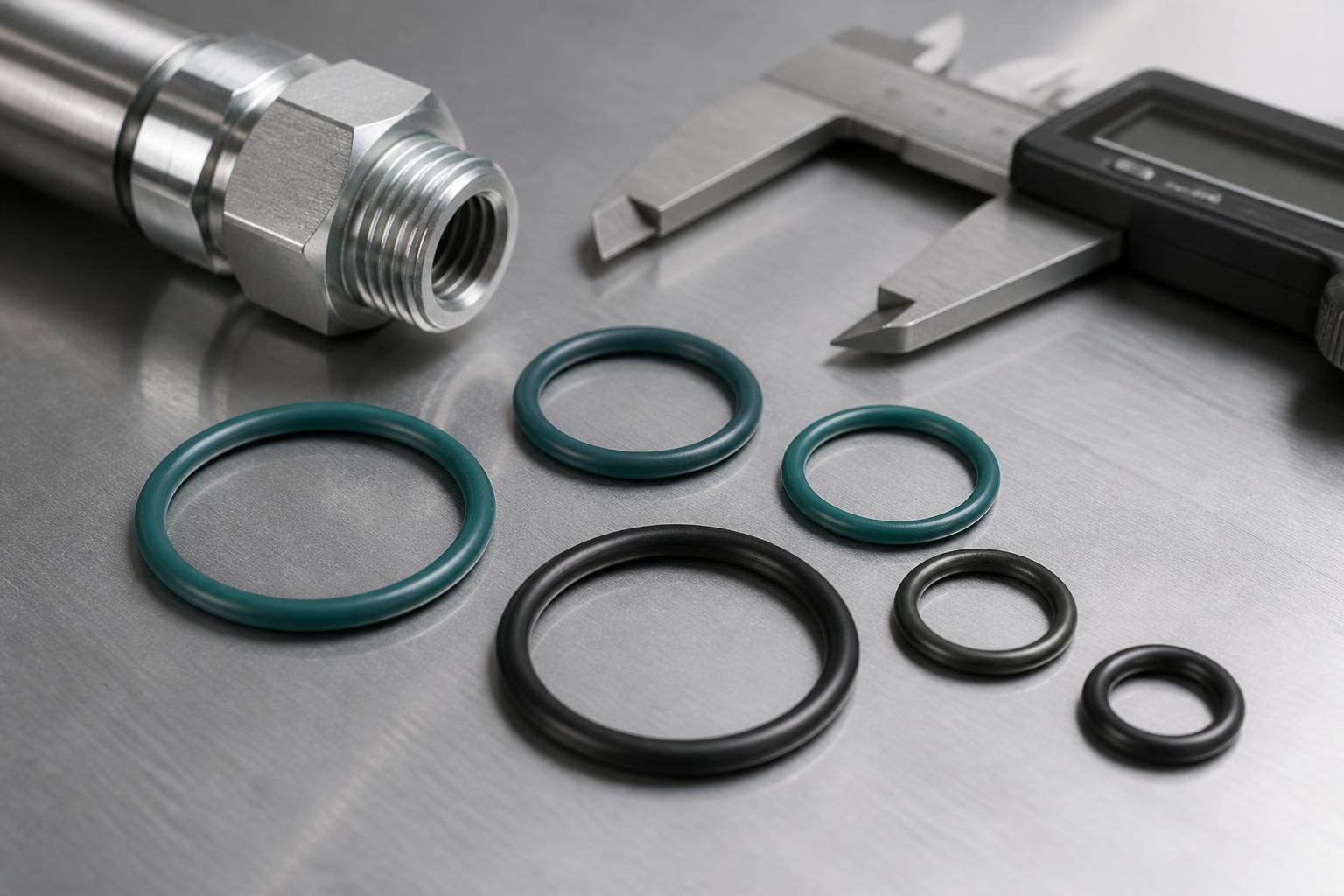
A note on colour: AMS-R-25988 material is conventionally blue, which makes it visually distinguishable on the bench and during inspection. Colour is a convention, not a specification requirement, and it is never a substitute for batch traceability.
AMS-P-5315: nitrile, and the cost-effective default
AMS-P-5315 covers nitrile (NBR) packings and gaskets for petroleum-based hydraulic fluid service. It is the aerospace equivalent of the workhorse nitrile that dominates industrial hydraulics, held to a defined and qualified set of properties.
Nitrile's aerospace envelope is narrower than either of the other two families here. Continuous service tops out around 100–120 °C, and low-temperature performance depends heavily on acrylonitrile content: a higher-ACN compound gains fluid resistance and loses cold flexibility, and vice versa. That trade-off is the single most useful thing to understand about nitrile, and it is precisely what a qualification specification pins down.
Where it earns its place: hydraulic system seals in petroleum-based fluid at moderate temperature, and ground support equipment where the thermal envelope is far gentler than airborne kit. Where the environment allows nitrile, specifying anything more exotic adds cost without adding life.
Where it is the wrong choice: phosphate-ester hydraulic fluids of the Skydrol family will destroy nitrile. Those systems need EPDM or butyl - and this is one of the most common and most expensive material errors we see, because the fluid is often assumed rather than confirmed.
AMS 7276: FKM, and the high-temperature end
AMS 7276 covers fluorocarbon (FKM) rubber O-rings for fluid resistance at elevated temperature - the specification to reach for when nitrile runs out of heat and fluorosilicone runs out of mechanical toughness.
FKM gives continuous service to around 200 °C with short excursions above, excellent resistance to petroleum fuels, mineral and synthetic oils, and the mechanical properties to survive dynamic duty. It is a genuinely capable material and it is priced accordingly.
Its limitation is the cold end. Standard FKM compounds have a glass transition around −20 °C, so they stiffen where a fluorosilicone is still compliant. Low-temperature FKM grades push this down, at further cost. Where a component sees both engine-bay heat and altitude cold soak, that cold-end limit - not the hot end - usually decides the material.
Choosing between them
A workable decision sequence, in order of what actually eliminates options:
Confirm the fluid first, from the system specification and not from assumption. Phosphate ester rules out nitrile and FKM alike. Hydrocarbon fuel rules out ordinary silicone.
Then take the low-temperature limit, including cold soak at altitude rather than ground ambient. This is where fluorosilicone separates from FKM, and it is the limit most often underestimated.
Then the upper continuous temperature, with excursions rather than nameplate figures. This is where FKM separates from nitrile.
Then the duty. Dynamic sealing pushes you towards FKM or nitrile and away from the silicone family, whatever the temperature analysis suggested.
Cost comes last, and only between materials that survive the first four steps. An O-ring specified down to price and up for replacement at the next inspection is not a saving.
Sizing: the part the specification does not cover
Material specifications say nothing about dimensions. Aerospace O-ring sizes are conventionally called out to AS568 dash numbers, while European and general engineering work more often uses BS 1806 or ISO 3601-1. The size families overlap but are not interchangeable, and a dash number quoted without its standard is ambiguous.
Three sizing points cause most of the failures we investigate:
Compression (squeeze). Typical targets are 15–30 % for static seals and 10–20 % for dynamic. Too little and the seal cannot follow surface irregularity or accommodate compression set; too much and you accelerate stress relaxation and risk installation damage.
Groove fill. The cross-section must not exceed roughly 90 % of the groove volume at maximum thermal expansion. Elastomers are effectively incompressible: an overfilled groove has nowhere to go and extrudes past the clearance gap. On a fluorosilicone or silicone seal running hot, thermal expansion is significant enough to turn a groove that looked adequate at ambient into an overfilled one at temperature.
Stretch on installation. Above about 5 % inner-diameter stretch, the cross-section thins measurably and the squeeze you calculated is no longer the squeeze you have.
Where the pressure and clearance gap combine to risk extrusion, an anti-extrusion back-up ring is the fix - and it needs designing into the groove from the start, not added later.
The traceability side
On aerospace work the paperwork is part of the part. For every batch we run to these specifications we hold compound certification traceable to the raw material batch, cure records for the moulding process, and dimensional inspection results against the drawing. Where a customer requires it, that arrives as a first-article inspection pack; on repeat orders, as a certificate of conformity referencing the same traceability chain.
This is not administrative overhead bolted on at despatch. A batch without traceable compound certification cannot be certified against AMS-R-25988 or any other qualified specification, whatever the material actually is.
In practice
Most of the aerospace sealing enquiries that reach us fall into two groups. Either a specification is already called out on the drawing and the question is whether we can supply and certify it - usually yes, and the conversation is about lead time and batch quantity. Or the specification is open, in which case the useful conversation is about fluid, temperature envelope and duty cycle, in that order.
If you are re-sourcing an existing component, the most valuable thing you can send alongside the drawing is how the previous seal failed. Hardened and cracked points at a thermal or ozone limit. Swollen and extruded points at fluid incompatibility. Flattened without visible damage points at compression set. Each pattern narrows the material choice far faster than a datasheet comparison.
Send us the drawing and the service conditions, and we will come back with a material recommendation, the specification it is qualified against, and the certification that accompanies it.